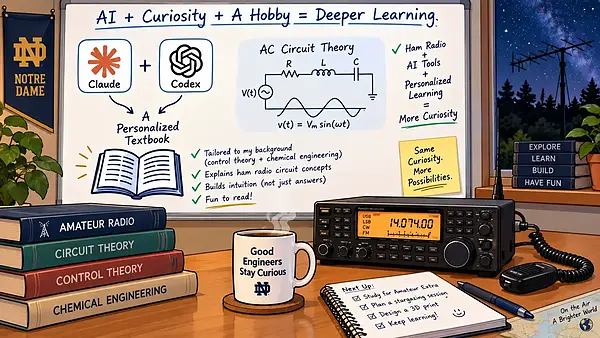
Over the last several months, I've been thinking a lot about how to use generative AI tools to help expand our creativity, especially with regard to leisure and personalized learning.
I've been experimenting with tools like Codex and Claude applied to my hobbies: designing a 3D print, planning a stargazing session, or, more recently, ham radio.
This summer, I earned my General Amateur radio license and got started with a new hobby.
Then, I started studying for the Amateur Extra (top-level) licensing exam. It covers AC circuit theory and calculations, but it has been two decades (this fall) since I took Physics II in college!
Instead of just memorizing the answers, my curiosity got the best of me. How can I learn this as bedtime reading, when I'm otherwise exhausted and winding down for the day?
I ended up using Claude and Codex to create a customized textbook tailored to me. This book, which started as a small document, explains these ham radio circuit concepts from the perspective of control theory and chemical engineering.
This was a lot of fun! It gave me firsthand experience crafting individualized learning tools, which has carried over into my teaching. Moreover, it helped me develop a new perspective on classical control theory topics.
At Notre Dame, we teach our controls classes completely in the state space. This allows us to save time by not teaching Laplace transforms, and to focus instead on things like nonlinear system dynamics, optimization, and model predictive control. But it also means we do not get to teach frequency-domain intuition.
As someone who has traditionally thought only about chemical engineering applications, I did not fully appreciate the frequency-domain perspective. It seems contrived to tell a class of undergraduate students to think about a distillation column with an inlet feed concentration that has a sinusoidal disturbance.
But my personalized textbook project has shown me how classical frequency-domain control theory naturally evolves out of electrical engineering. In radios, you inherently want systems that oscillate to transmit signals!
In summary, this has been a really fun experiment.
As we (society) discuss how AI impacts the future of work and education, I encourage everyone to experiment with AI tools to engage with a hobby and have fun!